Download Center


PLEASE NOTE: Service providers must obtain permission from Education for the Future to use any content or tools, downloadable from this site or published in any of our books or CDs.

For downloads related to questionnaire work, please visit the Questionnaire Resources section of our website.

Click on the Mac or PC icon next to the file description to begin downloading. Most files are compressed as a self-extracting file, with decompression being activated by double clicking on the files once they have been fully downloaded to your computer. If you experience problems decompressing the files, you may wish to visit a shareware site and download free decompression software (http://www.stuffit.com).


Continuous Improvement Continuums (CICs)

Assessing on the Continuous Improvement Continuums (also known as the CICs) will help staffs see where their systems are right now with respect to continuous improvement, and ultimately show that they are making progress over time. The discussion that leads to consensus is the most valuable piece of this activity. In addition to helping the entire staff see where the school or districtis, the discussion begins to write the sections of the school portfolio for them.

• CICs for School Districts: CICs_Dstrct.pdf (Adobe Acrobat File)
• CICs for Schools: CICs_Schls.pdf (Adobe Acrobat File)
• CICs for Special Ed: CICs_SE.pdf (Adobe Acrobat File)

Articles of Note

Continuous Improvement: It Takes More Than Test Scores
This article by Victoria L. Bernhardt, published in ACSA Leadership, summarizes why analyzing state assessment results is only the beginning of effective data-driven decision making.
TestScores.pdf (Adobe Acrobat File)

Data Tools for School Improvement
This article by Victoria L. Bernhardt, published in Educational Leadership, describes how data tools can help schools analyze and use data effectively. These strategies will help schools select an appropriate and effective data system.
DataTools.pdf (Adobe Acrobat File)

Databases Can Help Teachers with Standards Implementation
This article by Victoria L. Bernhardt, an invited monograph for the California Association for Supervision and Curriculum Development (CASD), describes how databases can help with standards implementation. Having a system to manage the learning mission is the most critical challenge for school districts to meet.
Dbases.pdf (Adobe Acrobat File)

Intersections: New Routes Open When One Type of Data Crosses Another
This article by Victoria L. Bernhardt, published in the Journal of Staff Development, discusses how much richer your data analyses can be when you intersect multiple data variables. Educators don’t need advanced degrees in statistics to begin gathering and using data in ways that will benefit schools and children.
Intersct.pdf (Adobe Acrobat File)

Multiple Measures
This article by Victoria L. Bernhardt, an invited monograph for the California Association for Supervision and Curriculum Development (CASD), summarizes why, and what, data are important to continuous school improvement.
MMeasure.pdf (Adobe Acrobat File)

No Schools Left Behind
This article by Victoria L. Bernhardt, published in Educational Leadership, summarizes how to improve learning for all students. Schools can get a better picture of how to improve learning for all students by gathering, intersecting, and organizing different categories of data more effectively.
NoSchls.pdf (Adobe Acrobat File)


Book Downloads

Table of Contents

Translating Data into Information to Improve
Teaching and Learning

This book helps educators think through the selection of meaningful data elements and effective data tools and strengthens their understanding of how to increase the quality of data and data reports at each educational level.


Table of Contents
Index of CD Contents

Using Data To Improve Student Learning Series Covers: Elementary Schools, Middle Schools, High Schools, Across School Districts
These books show real analyses performed at the district, school and classroom levels, using measures that are used at some grade levels, as well as consistent measures at every grade level over time. The splitting up of the topics allows for a thorough investigation of the analyses and program implications. Whether you are a district or school administrator, or a classroom teacher, one or all of these books will be right for you.


Table of Contents
Index of CD Contents

The School Portfolio Toolkit
The School Portfolio Toolkit is a book and compact disc (CD) that includes over 500 tools, strategies, templates, and examples for use in building school portfolios and working with staffs, as well as for use in planning, implementing, and evaluating continuous school improvement.


Table of Contents

The Example School Portfolio
This book represents one school's approach to building a school portfolio. This school neither began with a totally committed staff nor with the data they needed to make their decision making purposeful and in alignment with their vision. Over the three years represented by this portfolio, one can see what it took to get the data teachers needed to understand how to meet the needs of all their students and to understand what processes to change to get different results. Readers can also see how easy it is to look at another school and relate to how they operate.


Table of Contents

The School Portfolio
Easy to build and easy to use, a school portfolio is a non-threatening, self-assessment tool which exhibits a school's goals, progress, achievements, and vision for improvement. This book shows you how to develop a school portfolio specifically tailored to your school's mission, vision, and plan, reflecting unique challenges and opportunities.


Table of Contents

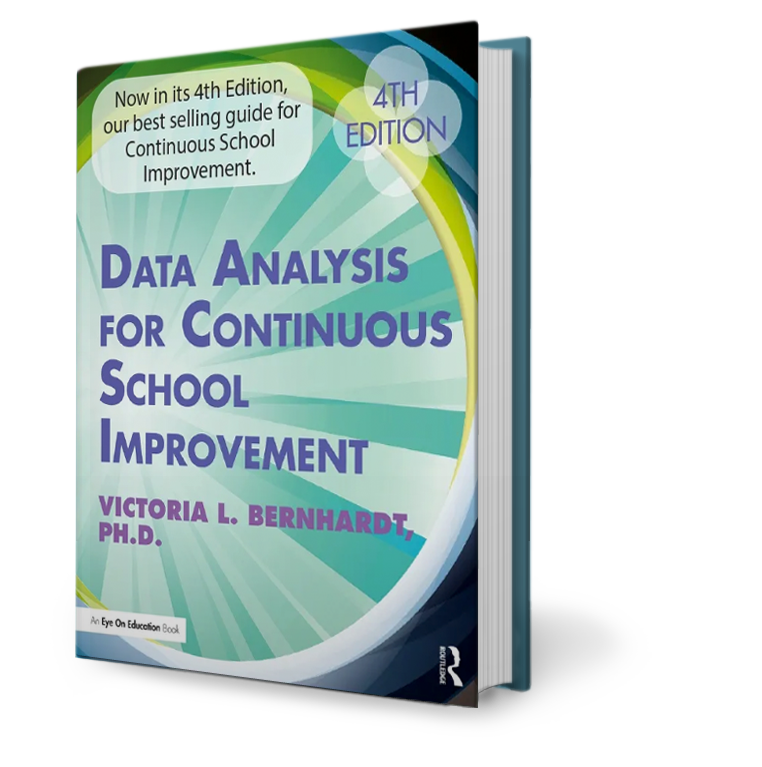
Data Analysis
With clear and concrete examples, we show you how to gather, analyze, and use data to improve all aspects of your school. Data such as demographics, school processes, student learning, and perceptions of the learning environment by teachers, students, administrators, and parents, can enable you to find out where you are, and where you want to be. Thus, how to get there becomes sensible and painless.


Table of Contents

Databases
Designing and Using Databases for School Improvement is about setting the foundation for the work that helps all of us continuously improve everything we do for students. It explains how to design a database to get the data analysis you want and need and use the data to continuously improve your classroom, school, and district.


Other Items of Interest

Download

Classroom Assessment Solution.
The CLASolution is an application initially designed to allow teachers to enter and analyze DRA data, with data entry and analysis provided for six assessments, for up to three periods per assessment. Assessments and analysis are defined by the user. This application can also be used to import and analyze existing data sets. This application is for demonstration only. For licensing information, please contact our office.


Download

Stranded Assessment Solution.
This application allows you to import raw student assessment responses, apply scoring and strand/cluster information to each question, and perform analysis by student and by class. Online templates, not included with this download, were designed to collect student assessment responses via the Internet. This application is for demonstration only. For licensing information, please contact our office.


Download Case Studies

Case Studies.
Download all of the case studies available on our web site as PDF files within a single compressed file.


Download Center
photo of children